Times of Malaya when Pioneers, Planters, Miners, Civil Servants, Merchants, Police and the Military - both regulars and volunteers, during British Colonisation period, lived in the Straits Settlements of Singapore, Malacca and Penang and the Federated Malay States of Perak, Selangor, Pahang, Negri Sembilan including Unfederated States of Johore, Terengganu, Kelantan & Perlis. From 1786, the arrival of Francis Light; 1819, landing of Stamford Raffles with the Honourable East India Company & the administration of the Straits Settlements by British India through to being The Crown Colony in 1867 leading to WW1 and WW2 in Malaya. The Times of Malayan Emergency to the independence of Malaya in 1957 and the Republic of Singapore in 1965.
Showing posts with label Penang. Show all posts

Monday, 29 August 2011

1859 to 1915 : Troops in Penang


1859 – 1915 : Troops in Penang

1860 reports on conditions of barracks in Penang. The hospital for the European and Native artillery requires ventilation and more for Sepoy dispensary. The Sepoy barracks was in good condition but the grounds need to be well drained and vegetation cleared.

1 Apr 1862 Penang Garrison of 20th Regt Madras NI was down to 243, after a detachment was sent to Labuan . After 183 on duty daily and 35 hospitalised, only 25 men was left for fatigue duty.

With completion of fortifications on Singapore, necessary to form “Local Company” of Madras Artillery for re-allocation of artillerymen in Straits Settlements. The whole of the “Local Company” was stationed in Penang.

1871 discussion of replacement of sepoy regiments with regiments of the British Army. 1872 last Sepoy regiment , 19th Regt Madras NI returned to Trichinopoly, India. The first “European Infantry” regiments arrive; the 80th(Staffordshire Volunteers) Regiment of the Foot arrived 17 March 1872

The regiment marched 3 miles from the docks to Tanglin Barracks Singapore. March 1872, D company moved to Malacca under Capt Charles Tucker

20 April 1872, A & B companies moved to Penang under Major Charles F Amiel. The remaining 5 companies stayed in Singapore

1894 Reduction of European force was discussed with replacement of certain elements with Native Troops. Proposal was rejected by Colonial Defence Committee in Feb 1894.

“Asiatic Artillery” were to be employed in the garrison. Approval was requested in June 1894, and was actually given on 29 Nov 1896.

March 1900, 16th Madras Infantry arrived to take over garrison duty from British troops due to the need to have British units available for service in South Africa.

16th Madras Infantry was relieved November 1901 and replaced by 2 regiments from the Indian Army – the 3rd Madras Infantry and the 13th Madras Infantry.

After the close of the South Africa war, the decision was made to increase Straits Settlements Command from 1 Battalion to 2. – One from British Army and the second battalion supplied by the Indian Army. As a result, 1st Battalion Manchester Regiment arrived in Singapore on April 1903 to relieve the 3rd Madras Infantry whilst 13th Madras Infantry remained until relieved by the 73rd Carnatic Infantry in Jan 1904.

With the outbreak of WW1 1914, British Infantry battalions were once again withdrawn leaving the 3rd Brahmans, which was relieved by the 5th Light Infantry that mutinied on February 1915

29 April 1915, Pasir Puteh, Kelantan, disturbance broke out ( 1 Police Sergeant Killed). Lt Col C W Brownlow with a force of 163 men from the 4th King’s Shropshire Light Infantry ( Territorial Force), 50 men from the Royal Garrison Artillery and 21 men from the Singapore Volunteer Infantry arrived at Pasir Puteh on 5 May 1915. The Malay States Guides (MSG) with 140 men and two machine guns reinforced the force on 13 May 1915. The HMS Cadmus shore party supplemented the expedition. After 10 days, the disturbance subsided with little oppositions and the force returning to Singapore and the MSG detachment left behind to police the area.

The MSG remained in Kelantan until Sep 1915 when they departed for overseas duties in Aden. They were relieved by a force of 1 officer and 38 men from the Malay Company, Penang Volunteers and 2 officers and 24 men from the Singapore Volunteer Infantry. After their departure on Nov 1915, the Special Constables ( later the Kelantan Volunteer Rifles) took over control of the area.

Extracted from British and Indian Armies in the East Indies by Alan Harfield

1830 to 1858 : Troops in Penang


1830-1858 Troops in Penang

Detachment of 15th Regiment Madras Native Infantry stationed in Penang was sent to Singapore for Garrison duties in 1835, with the departure of 6 companies of 29th Regt Madras NI in Jan 1834 from Singapore. IN Jul, 1835, 48th Regt Madras NI arrived for garrison duties for Singapore & Malacca.

15th Regt Madras NI, Penang lost CO, Lt Col Gregory Jackson on 31 March 1835.

Penang Gazette was started in 7 April 1838, published weekly with the Prince of Wales Gazette.

1837 March, 12th Regt Madras NI replaced 15th regt as Garrison Troops

1840, Singapore became the transit station for troops proceeding to the China Expedition.

1840, 12th Regt Madras NI departed for Palaveram and was relieved by 24th Regt Madras NI for Penang Garrison. The regt also took over duties of protecting Malacca with detachment due to the hurried departure of 39th Regt Madras NI ( Garrison duties for Singapore and Malacca) who joined the China Expedition in June 1842

Monday 19th Sep 1842, a Royal Salute of 21 guns was fired, on knowledge that Peace has been concluded with China

27th Regt Madras NI from Vizagapatham took over 24th in Penang, with delay due to severe bad weather in Bay of Bengal.

1846, garrison force of Singapore, Malacca and Penang of 2 NI regiments has been reduced to 1. The unit covering the 3 stations was 27th Regt Madras NI ( Officers wore black facings with silver lace).They were replaced on the last day of April 1846 by 21st Madras NI ( officers worn buff facings with gold lace)

51st Regt Madras NI was earmarked to serve in Penang & Malacca. But was garrisoned in Singapore instead and relieved 21st Madras NI on April 1849

The work of garrison troops was a routine of drill and guard duties. With the officers attending social functions that was held in Vistorian Singapore, Malacca and Penang.

April 1852, 51st Regt Madras NI departed to Vellore and was relieved by 43rd Regt Madras NI.

1853, The Garrison of Penang was by then a subordinated unit to Singapore. The Regiment HQ was in Singapore and outstations at Malacca and Penang

1854, The Governor was requested to set Rules for the guidance of a Volunteer Rifle Corps

Early 1855, 29th Regt Madras NI ( CO Lt Col J Richardson, died in Penang on 15 Sep 1856) became the garrison regiment of Penang. Singapore’s 43rd Regt Madras NI heading to Vizagapatam was to be relieved by 38th Regt Madras NI in April 1855

29th Regt Madras NI band of the regiment ( John Brahm, bandmaster) was popular and gave performance in the Lines. Capt Henry Cazalet in 29th was also an accomplished artist. His paintings dated 1856 – 57 . Popular painting “Penang from the Harbour 1856”. 29th moved to Masulipatam and then to Kamptee in 1860 where Cazalet died from cholera in 5 March 1860

1857 Resident Councilor at Penang requested guidance of control of Sepoy military guards over convicts housed in Jail and the Convict Lines. OC Troops at Penang pointed out that the Military Guard was to support the Civil Power in the exercise of power over the inmates. April 1857 there was a riot in Penang which the Garrison of Penang acted nobly.

1858 Jun/Jul Lt George Towers Hilliard of 50th Regt Madras NI who was Superintendent of Convicts and Executive Engineer, was recalled to India to suppress mutiny. He departed on 17 Jul onboard P&O Steamer Pekin for Galle & Madras. Jul 1858, Lta W S Mitchell of 22nd Regt Madras NI was appointed when George was recalled.

Sat 13 Nov 1858, Straits Settlements ceased to be under the Company and became a Crown Colony

Penang Garrison Troops

1859 22nd Regt Madras NI left for Madras on same ships that brought replacement 20th Regt Madras NI

1861 20th Regt Madras NI arrived 18 April after leaving Madras on 8 April by steamer Arracan and transport Jubal Cain.

1864, 16 Feb, arrival of 35th Regt Madras NI and departure to Madras on 1 Apr 1868. Replaced by 7th Regt Madras NI whom arrived on Penang, 17 Mar 1968, and moved to Singapore on 12 May 1869 to garrison the whole Straits Settlements

Extracted from British and Indian Armies in the East Indies by Alan Harfield

1786 to 1830 : Troops in Penang


1786 – 1830 Troops in Penang

17 July 1786, Capt Francis Light, Sea Capt of the Honourable East India Company, arrived off Penang Island with 3 ships. The ships were Eliza, Speedwell and Prince Henry

-Capt Light took the Island from Sultan Abdullah of Kedah ( Queda), on behalf of the Company and named the Island Prince of Wales Island ( name remained on record for next 50 yrs)

-10 Aug 1786, 2 East Indiamen arrived off Penang enroute to China - The Vansitart & The Valentine.

-11 Aug 1786, Captains of the two ships landed and took part in the Flag raising Ceremony. Lta James Gray – Commandant of Marine detachment, Capt Elisha Trapaud ( Engineers) & Cpt George Howell ( Artillery) were present

-Fort was built with timbered stockade with ditch – bastions solid to hold 6 pounders from the ship. Fort was named Cornwallis, after Governor General in Calcutta, Lord Cornwallis

-size of settlement grew and the town grown next to the fort was named Georgetown, in honour of His Majesty, King George III.

-1788, 3 officers served in Penang -Lta John Glass ( artillery), Lta George Rahen & William Murray ( Fireworks), and unnamed officer of the Marines

-1790,Calcutta sent 2 companies of Native Infantry (NI) and 10x 18 pounder guns for defence of Penang Port, under commandant Capt Glass

-1791 19 March, Sultan of Kedah forces and Lanun Pirates in 90 prahus sailed and set up forts on mainland opposite Georgetown

-Bombay Castle, 1 of the East Indiaman from the squadron of ships (which sailed to Penang on Feb 1791, and left to Madras on 15 Mar) from Commodore William Cornwallis remained in harbor. Capt Glass on 12 Apr 1791 attacked the forts of the Malays & Lanun. 10,000 were defeated and 250 armed prahus dispersed.Capt Glass losses were 4 men killed.

-5 Apr 1793, Capt Glass, Commandant of Penang Garrison, died – buried at Northam Cemetery. He was succeeded by Capt Hamilton

-1794, Maj Alexander Kyd, Bengal Engineers to review defence of the Penang Garrison

Capt Light has already rebuilt Fort Cornwallis as a stone structure at costs of 7,000 without approval of his Bengal superiors

-Capt Light died 21 October 1794

-14 May 1795 Maj Forbes Ross MacDonald took command of Penang

-1800 Sir George Leith was Lta Governor of Penang and negotiated with Sultan Kedah for Province of Wellesley, 7 July 1800

- 1801, Defence establishment :

Commandant Maj Thomas Polhill, 7th Regt Bengal NI ( Lt Col on 4 Jan 1801)

Adjutant & QM Lta Norman Macalister, Bengal Artillery

Commission of ordnance Lta Charles Sealy, Bengal Artillery

Engineer Capt Joseph Stokoe ( died 12 Jan 1801),Successor Lta John Gordon ( died 12 Nov 1804), and Bengal Engineer

Medical Surgeon James Hutton & Asst Surgeon Henry Waring, Bengal Medical Dept

Infantry Lta John Lindsay, 10th Regt Bengal NI, Lta John Leslie 5th Regt Bengal NI, Lta Conell Simpson 14th Regt Bengal NI

-1805 East India Company upgraded Penang Settlements status to Presidency

-Sep 1805 Thomas Raffles arrived and was Lt Governor of Java after campaign 1811.

-1805 Local militia formed – Prince of Wales Island Local Corps; disbanded jul-aug 1806.

-1806, Capt Thomas Robinson, Engineer & Surveyor was tasked to submit plans to defend attacks by European Naval force & another second fort

- life of garrison routine was guard duties and drills, occasional range practice as ammunition was expensive

-17 Oct 1806, Garrison troops – 6th Regt, 10th Regt 20th Regt, 24th Regt of the Bengal NI, Regt of Artillery, Bengal & Medical Department.

-End of 1809, extension and new batteries of twenty feet thick mounting 17 Heavy guns was constructed at costs of over $4,500. The improvements made Fort Cornwallis the best defended fort in the Far East

- Penang was staging area for naval vessels and troops ships.

- As France overrun Holland on Jan 1795, the Dutch in Malacca was a threat to Penang. Expedition to attack Malacca was launched from Madras with 4 European Battalions under Maj Archibald Brown and Penang was the staging port

-1797 expeditions to invade Manila used harbour as rendezvous point.

-1807 – 1808, 2nd Battalion of HM 1st or Royal Regiment under Lt Col Gales assembled for Moluccas Campaign ( they were occupying force at Balambangan from 29 Sep 1803 to 1805)

-1811, invasion of Java force called at Penang port before assembly area in Malacca

-Penang military establishment expanded so that troops were provided for Malacca and Singapore

-1820, Local Unit, Penang Local Corps, was raised to save expense of having regiment from Madras Army. Lta James Low recruited from Upper Provinces of Bengal to be used as defence force in Province of Wellesley against piracy. Low was in command until 1827, when unit was disbanded. Majority of the soldiers returned to Bengal on the ship Flora.

-1826, Straits Settlement Presidency founded, comprising Penang, Malacca and Singapore

-Presidency was abolished by Lord Bentinck and a single residency on 1 May 1830 was formed instead with Penang as HQ of the Residency until 1832.

Extracted from British and Indian Armies in the East Indies by Alan Harfield

Tuesday, 23 August 2011

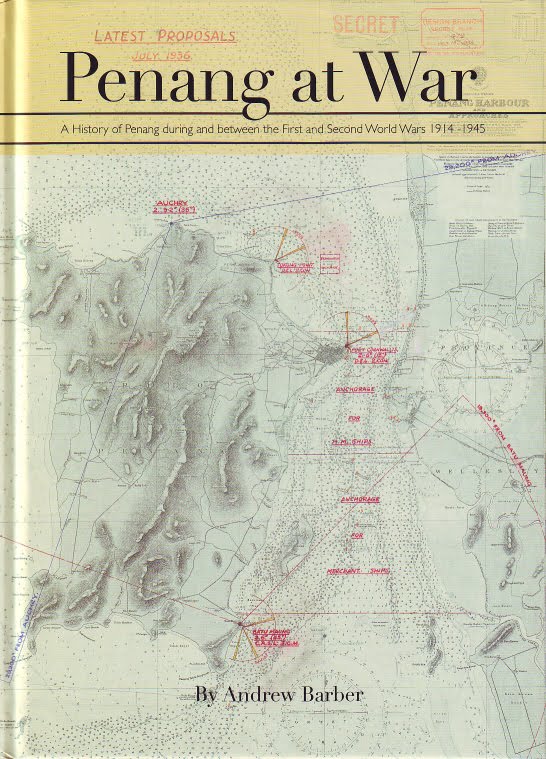
Penang at War, by Andrew Barber

Penang at War ( good source of information in relation to Penang before & during WW1 & WW2)

1898 - Penang was not fortified or protected by heavy guns

- Command of Penang consisted of Central Reserve and outpost observation lines & cycle posts of observation

- Central Reserve comprised 1 company Malay Scout Guides, 1 company Penang Volunteers (PV) and half company of Sikh Police ( 50 men)

- Penang was a hub in the global network of Imperial Telegraph Cables. There were 6 cables under the Eastern Extension Telegraph; 2 cables connected with Madras, 1 with Belawas (Sumatra), 2 cables to Singapore and 1 to Malacca.

- Given the connection, Penang was a critical telegraphic communications hub.

- Penang Volunteer (PV) main responsibility was to defend the telegraphic cables during WW1. (PV was formed in 1861)

-PV was mustered at the fort (Fort Cornwallis?) and marched to Penang Club, to take up positions to defend the Cable House at Northam Road. ( Reason why Penang Volunteers HQ was located at Peel Avenue, a short marching distance away from Northam Road. The HQ was moved from Kampung Bahru, Northam Road then to Peel Avenue)

-British regulars didn’t arrive by 1917 and PV were paid Straits $1 per day to defend the cable house under Eastern Extension Telegraph Company.

(1906 - Penang Volunteers Commandant Lt Col A R Adams, with adjutant Lt Alan Wilson)

July 1914 – PV has 200 men – drills on weekends, local exercises and training camps. An Exercise had the PV defended Penang successfully against an attack by a contingent of Malay State Guides.

May 1915 – “Town Guard” of 60 men established to police Penang Town

Sep 1915 PV increased to 257 men, with 165 aged 18 – 40 yrs old.

Jan 1916 – Governor of Penang allowed a “Double Company” of Chinese Volunteers – Straits Born Chinese.

Nov 1916 – Eurasians and European Allies were admitted into the PV

-Lt Col A R Adams (Boer War Veteran) awarded “Colonial Volunteer Medal” for sending PV to Singapore in 1915 to help deal with the 5th Light Infantry mutiny

-Malay Platoon from Province of Wellesley (PW) Volunteers recognized by Governor of Penang in suppressing Toh Janggut rebellion in Kelantan

1917 – Force of Coast Defence Volunteers added, with a Mounted Corps. Duties of PV was to detain and escort to internment in Singapore of Penang’s German community.

July 1917 – Malay Company of Volunteers disbanded; distrust of Muslim subjects ( probably as a result of Mutiny in Singapore and locals rebellion)

1935 Defence Paper - Planners developed 3 layers of force deployment

- Singapore was the core of the defence scheme

- 2nd layer was the defence of Johor; landward gate to Singapore and was source of food and water

- Outer layer was the defence of Malaya north of Johor. Penang was considered important as it was the port of entry for reinforcements and potential airbase for Northern Defence.

- Established HQ 3rd Battalion Straits Settlement Volunteer Force, SSVF ( Penang & Province of Wellesley Volunteer Corps, PPWVC) in Penang – 1 mechanised company, 3 infantry companies and 1 arms depot

- 2 long range surveillance sea planes operated from Glugor Harbour, Penang

1937 Malaya Defence Scheme upgraded Penang as “Fortress” as Penang was seen as a port and communications hub for international cables. Penang was also selected as a “convoy assembly point” from ships in the Indian Ocean.

1937 SSVF Annual determined the role of SSVF as an integral part of the front line garrisons of the country

Jan 1937 – Mock exercise held by Royal Navy and the Raf in Penang

Jan 1938 – Proposed defence works for Fortress Penang was not completed. Building of small fort at Batu Muang and concrete pill boxes around Penang Aerodrome and gun emplacement in Fort Cornwallis will be delayed till 1940, even though Penang was identified as a potential port to dock cruisers and submarines

1938 3rd Battalion PPWVC established, consisted of 3rd Battalion SSVF, 1 European Machine Gun Platoon ( PW), 1 Malay Rifle Company (PW), 1 Medical Section ( Penang) and HQ Reserve

3rd Battalion PPWVC Commanding Officer: Lt Col Buriatte (Straits Settlement Legislative Council), Staff Captain: Malcolm Moffat (Penang Businessman & WW1 veteran). Assisted by two regular army trainers from the Coldstream Guards and the Wiltshire Regiment

1939 – commenced tactical exercises including night operations and battle practices.

B company was the main fighting force of 140 Europeans in 3 platoons & Lewis gun units. 50 Europeans were in reconnaissance, signals & Intelligence specialists units.

B company fought on the mainland of Malaya with General Heath 3rd Indian Corps.

A company had 140 Malay Officers and men. D Company was under Capt The Ah Yong, which was 80 strong.

E Company had 60 Eurasians under Capt Toolseram. The battalion had Indian Ambulance drivers, signals and support staff.

Fortress Penang was established with a prewar notion that an anticipated scenario was a defence against a naval assault

1940 – Grand Plans for 2 major forts at Batu Ferringhi and Muka Head with 2x9.2 inch naval guns. By 1941, most such plans were still on charts

Jan 1940 Shenton Thomas promulgated the Compulsory Services Ordnance for conscription of British Males 18 – 55 yrs old : most were trained and served in the volunteers

1940, Batu Muang Fort was completed , with armaments of 2 x Naval 6 inch guns and 4 x 4 inch guns guarded the South Channel

Muka Head Fort to cover the North Channel was never built. A gun emplacement at Fort Auchery was set up instead.

Major General Lyon ( Tiger Lyon) commanded the Penang Garrison

As Penang was to guard the West Coast of Malaya and the Straits of Malacca, Tiger Lyon requested for 28 Anti Aircraft guns that never arrive.

Since 1937, Penang was termed as a fortress. In Dec 1941, “it’s far from being one” as commented by General Percival after the war.

Feb 1941 – Police was involved in wartime planning. Penang Acting resident councilor Lesley Forbes headed “Passive Defence Services”. Strength of civil services stood at 1,000 strong air raid wardens, medical auxiliary services and Local Defence Force.

Sep 1941 – Major 3 day exercise involved civil defence was conducted in Penang

7 Dec 1941( Eve of Japanese invasion), Fortress Penang’s defences included:

- 11th Coastal HKSRA ( 2 x 6 inch batteries)

- 36th Fortress Company Royal Engineers ( Search lights)

- 1 company 5/14th Punjab Regiment

- 1 independent Company

- Detachment of 3rd Indian Calvary

- 3rd Battalion PPWVC, SSVF

- Administration detachment

There were no arch lights and anti aircraft guns

Penang and the mainland opposite was the fall back position should 11th Indian Division fall back from Jitra. This Defence axis would be reinforced by 2 additional battalions

Tiger Lyon was responsible for the island and the sector on mainland i.e. Prai and Butterworth ( Port & Aerodrome) and communication route to the North of Malaya.

Extracts from “Penang at War” by Andrew Barber