Times of Malaya when Pioneers, Planters, Miners, Civil Servants, Merchants, Police and the Military - both regulars and volunteers, during British Colonisation period, lived in the Straits Settlements of Singapore, Malacca and Penang and the Federated Malay States of Perak, Selangor, Pahang, Negri Sembilan including Unfederated States of Johore, Terengganu, Kelantan & Perlis. From 1786, the arrival of Francis Light; 1819, landing of Stamford Raffles with the Honourable East India Company & the administration of the Straits Settlements by British India through to being The Crown Colony in 1867 leading to WW1 and WW2 in Malaya. The Times of Malayan Emergency to the independence of Malaya in 1957 and the Republic of Singapore in 1965.
Showing posts with label Perak. Show all posts

Monday, 5 September 2011

70th and the 20th Burma Rifles Regiment 1919 to 1936, Taiping, Perak : Malaya Garrison Troops

Burma Rifles Range Shooting ( Army life in the "90s, P. Warner)

The Burma Rifles was the Garrison Troops for Malaya, based in Taiping, Perak from 1919 ( after the disbanding of the Malay State Guides 1873 - 1919 ) to 1936 ( Replaced by the 1st Battalion 2nd Punjab Regiment 1936 - 1938 )

-The Burmese Pioneers was raised in late 1915. Gurkhas and Sikhs formed the backbone of the various forces raised in Burma

-Sep 1917, Burmese Pioneers turned into an Infantry Regiment, becoming part of the Indian Army as the 70th Burma Rifles. The Regiment depot was at Meiktila and Maymyo for recruitment.

-Altogether, 4 Battalions were raised for 70th Burma Rifles. British and native officers commanded the battalion on same pattern as regular Indian army regiments. Few of the British officers learn the language or learn about the Burmese ways

-1st Battalion 70th Burma Rifles sent to the Suez in May 1918 at Tel El Kebir to guard the Lines of Communications and Turkish POWs.

-2nd Battalion 70th Burma Rifles was sent to Egypt after the fighting ended and was assigned garrison duties.

-April 1918 and June 1918, the 3rd Battalion and 4th Battalion were formed respectively.

-a second Regiment, 85th Burma Rifles was raised in Mandalay on Jul 1917 mostly with Indian Volunteers from the Burma Military Police(BMP); Burma’s oldest military formation . It trained in India before going to Basra Iraq.

-The 4 companies comprised platoons of Sikhs, Punjabi Muslims, Gurkhas, Burmans, Karens and Kachins. Garhwali’s & Kumaonis were enlisted when the Burmans & Karens quota was not met.

-The 85th was 1,500 strong by end of WW1

-The BMP was a colonial gendarmerie made up of Indian troops. Origins dated back to the annexation of upper Burma in the third Burma war of 1885. Irregular Indian troops were recruited to pacify countryside and crush remains of royal Burmese army

-the Indian levies formed the bmp and the battalions were recruited for a period as needed in various areas and later disbanded. At any one time, 12 battalions existed and more than 50 battalions were formed through the years

-units were named after region or locations where they served i.e. Southern Shan States Battalion, Ruby mines battalion. Each battalion had a mounted infantry often Sikhs and duties included providing Governor’s bodyguard

-British policy used paramilitary forces for internal security as they handle broad array of task and far cheaper to equip and run than army units

‘The bmp is a semi military force intended to perform at the cheapest cost as

a- Frontier watch and ward duties

b- Deal with minor insurrections amongst the less civilized hill tribes

c- Transport treasures

d- Guard and transport long term prisoners to from jails

-1920, 70th and 85th merged in a single regiment as 70th Burma Rifles. Burmans, Karens & Chins formed the backbone of the new formation

-1921, the Regiment was restructured into 4 Battalions- 1/70th Burma Rifles, 2/70th Burma Rifles, 3/70th Kachin Rifles & 4/70th Chin Rifles

-1923, the Regiment became 20th Burma Rifles as part of 1922 reorganisation of the Indian Army – with mixed class and race units. They were 1/20th Burma Rifles, 2/20th Burma Rifles, 3/20th Burma Rifles, 10/20th Burma Rifles ( Depot & Recruitment Battalion) & 11/20th Burma Rifles ( Territorial Battalion)

-1925, Burmans were removed from the 20th Burma Rifles; recruiting Chins, Kachins, Karens and other minorities as doubts of Burman loyalty and ingrained prejudice was the main reason

-1 April 1937, Burma became a separate British Colony and administrative control from India was shifted to London. The 20th Burma Rifles left the Indian Army and was the foundation of the New Burma Army

Extracted from Forgotten Regiments, Barry Renfrew

Thursday, 11 August 2011

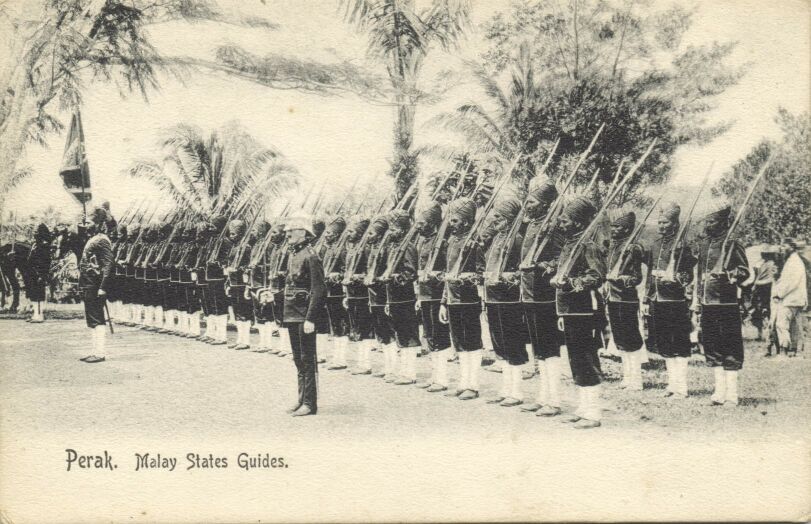
Malay States Guides (2) Perak

Malay State Guides shooting at Bisley for the Kolapore Cup, 1908


Malay State Guides ( MSG) 1902 - 1919

Most were sepoys who served in the Indian Army and the European Officers came from the British & Indian army. Native Officers were commissioned by the Governor of the Straits Settlements.

Maxim machine guns were equipped and a battery of 150 gunners and 50 mule handlers , gunned with 7 pdr mountain guns with two 15 pdr field guns were formed. The gunners wore dark blue uniforms and turbans

Early years, the Imperial Defense Committee in London rated the unit as efficient.

1902 – Walker was Lt Col as commandant of the Malaya States Guides and retired in 1910

1910 – Col Murray from the 89th Punjab Regiment was commandant till 1912

1913 – Col OHB Lees from the 53rd Sikh Regiment was CO and led the unit to Aden in 1915

Problems with MSG

- The force did not belong to the Indian nor the British army

- Nor was it a police force

- There was no real true purpose as too much time drilling and little time training for war. Peace, ceremonial soldiering and lack of purpose have sap the regiment’s morale.

Proposed to send MSG overseas on active service was declined as War Office view the MSG as Local Constabulary.

1914 – Was sent to Singapore to embark for service in East Africa. MSG refused as contract obliged them to serve in Malaya. Possible reasons were reports of high casualties in Africa, reluctant to leave businesses built in Malaya during spare time and anti-British sentiments in the ranks.

- Infantry returned to Taiping whilst battery remained in Singapore to bolster defenses after withdrawal of British Battalion.

1915 5 Feb – 5th Light Indian Infantry shared same issues as MSG and mutinied.

1915 – MSG helped to suppress native revolt in Northern States of Kelantan and agreed for overseas services with new contracts in fear of losing livelihoods and careers in case of disbandment.

1915 Sep – MSG joined the Aden Field Force with 900 officers and men, and Tamil laborers.

1919 – MSG returned with 500 men – the death toll was due to sickness rather than battle casualties as most were stricken with diarrhea and dysentery.

Late 1919 – MSG was disbanded due to forgotten theatre in Aden, doubts about their value and CO’s recommendation. Mainly, the men were worn out by Aden’s harsh conditions and decided to return to India. Those remained joined the Federated Malaya States Police Force.

Bibliography : Forgotten Regiments by Berry Renfrew and Google search

Malay State Guides (1) Perak


Malay State Guides (MSG) 1837 - 1897

- As British Influence spread across Malaya, Sultans formed modern constabularies with British assistance to suppress lawlessness in their states

- Forces were modeled on Indian Army and employed British Officers & Indian Sepoys

- MSG soldiers have to be 5 ft 9 – a third of them were 6 ft and wore red tunics & green turbans with silver edgings

Origins of the MSG

Captain Tristian Speedy was a police superintendant in British Penang hired by Mentri, Ngah Ibrahim of Larut to form a Military Police Force

1873 – Resigned as a police official and He returned to Punjab to recruit 110 Sikh sepoys to form the Perak Armed Police

Fought with British force of 200 infantry from 1/ 10th regiment (Penang) and 80th foot regiment(Hong Kong) in Perak war 1875-6 after the murder of First British Resident of Perak. Isabella Bird’s The Golden Chersonese might have mentioned them as “irregulars”.

Lt Col Robert Sandilands Frowd (RSF) Walker (Regular Army Officer) was aide de camp to Sir William Robinson, Governor of Straits Settlements in 1878

1879 - He was named Perak Commissioner of Perak Armed Police, taking over from Major Paul Swinburne

1883 – He recruited 250 Sikhs and Pathans from the 14th/15th & 45th Regiment of the Indian Army

1884 – Unit has 650 men, mostly Indians & 100 Malays. Renamed as 1st Battalion Perak Sikh Military Police ( 1st Perak Sikhs ), with Walker as the commandant with local rank of Major. Selangor & Pahang formed Sikh Military Police Forces on similar lines and helped quell the Pahang rebellion in 1891. The State of Selangor has 530 Selangor Sikhs under Captain H.C.Syers and Pahang has , in 1890 13 Sikh police in Jelebu under Inspector Henessy.

1895 – The Federated Malaya States was formed. The treaty requires all states to maintain a military force. A regular infantry regiment was then formed from the redundant Sikh military police force units

1896 – The regiment was renamed Malaya States Guides, an imitation of India Army’s famous Corps of Guides. 6 companies ( Composition : 4 Sikh comprised Majha Sikhs from Amritsar, Gurdaspur & Lahore in A & B companies, and Malwa Sikhs from Ludhiana, Ferozepur, Ambala, Nabha & Patiala formed C & D companies- the remainder Doaba Sikhs from Jullundur & Hoshiarpur could join any Sikh companies, 1 Punjabi Muslim & 1 Pathan companies) were formed, with a depot company for training recruits. ( A 7th company was raised temporarily during the Boer War to garrison Penang after British troops withdrawn). There were 10 Officers, 8 Native officers & 596 NCOs and men. By the onset of WW1, the force has grown to 900 men.

1897 June - The regiment was sent to march in Queen Victoria’s Diamond Jubilee in London

Friday, 26 November 2010

Eat, Talk, Coffee.. etc in Kedai Kopi, Kopi Tiam Malaysia/Singapore – No 5

Oops, a wine shop in Ipoh...but its next to the famous Ipoh White coffe, Kopi Tiam in Old Town

A gathering in a Kopi Tiam in Balik Papan


The service station of a Kopi Tiam in a prewar shop house in Taiping


Rolling dough in Hoong Toh, Ipoh for their famous Chinese pastries

Monday, 9 August 2010

Concubine lane, Lorong Panglima..Ipoh, Perak

A vacated house in Concubine Lane ( Lorong Panglima)

A trishaw(?) going through the lane

Washings hanging dry across the lane, near to Wong Koh Kee Restaurant

Horizontal bars functioned as a security gate and for ventilation when the wooden doors were opened. A vintage design for prewar houses

Reported to have housed opium dens, mistresses for the rich tin tycoons in the heydays of Ipoh. It could have just been another bygone residence for the townsfolk of Ipoh – most of whom were petty traders or hawkers. The “Yee Lai Hong” or concubine lane appeared to be pretty derelict except for the Wong Koh Kee Restaurant that was doing brisk business for the lunch crowd.