Times of Malaya when Pioneers, Planters, Miners, Civil Servants, Merchants, Police and the Military - both regulars and volunteers, during British Colonisation period, lived in the Straits Settlements of Singapore, Malacca and Penang and the Federated Malay States of Perak, Selangor, Pahang, Negri Sembilan including Unfederated States of Johore, Terengganu, Kelantan & Perlis. From 1786, the arrival of Francis Light; 1819, landing of Stamford Raffles with the Honourable East India Company & the administration of the Straits Settlements by British India through to being The Crown Colony in 1867 leading to WW1 and WW2 in Malaya. The Times of Malayan Emergency to the independence of Malaya in 1957 and the Republic of Singapore in 1965.

Tuesday, 23 August 2011

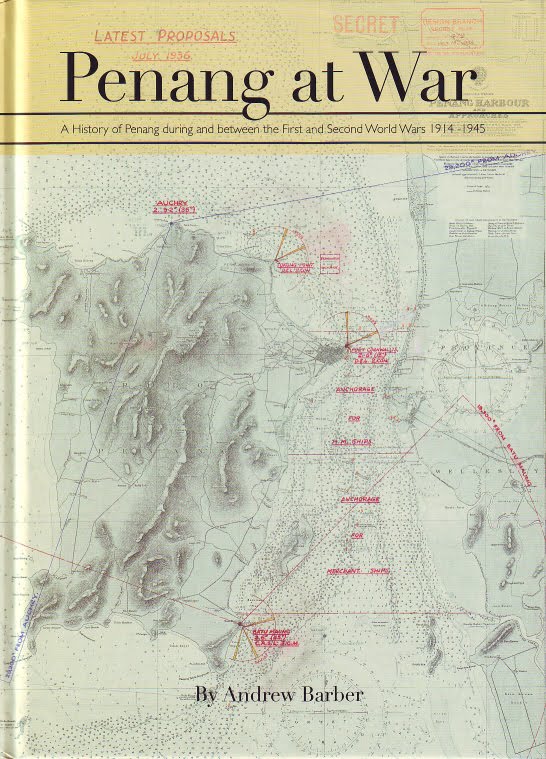
Penang at War, by Andrew Barber

Penang at War ( good source of information in relation to Penang before & during WW1 & WW2)

1898 - Penang was not fortified or protected by heavy guns

- Command of Penang consisted of Central Reserve and outpost observation lines & cycle posts of observation

- Central Reserve comprised 1 company Malay Scout Guides, 1 company Penang Volunteers (PV) and half company of Sikh Police ( 50 men)

- Penang was a hub in the global network of Imperial Telegraph Cables. There were 6 cables under the Eastern Extension Telegraph; 2 cables connected with Madras, 1 with Belawas (Sumatra), 2 cables to Singapore and 1 to Malacca.

- Given the connection, Penang was a critical telegraphic communications hub.

- Penang Volunteer (PV) main responsibility was to defend the telegraphic cables during WW1. (PV was formed in 1861)

-PV was mustered at the fort (Fort Cornwallis?) and marched to Penang Club, to take up positions to defend the Cable House at Northam Road. ( Reason why Penang Volunteers HQ was located at Peel Avenue, a short marching distance away from Northam Road. The HQ was moved from Kampung Bahru, Northam Road then to Peel Avenue)

-British regulars didn’t arrive by 1917 and PV were paid Straits $1 per day to defend the cable house under Eastern Extension Telegraph Company.

(1906 - Penang Volunteers Commandant Lt Col A R Adams, with adjutant Lt Alan Wilson)

July 1914 – PV has 200 men – drills on weekends, local exercises and training camps. An Exercise had the PV defended Penang successfully against an attack by a contingent of Malay State Guides.

May 1915 – “Town Guard” of 60 men established to police Penang Town

Sep 1915 PV increased to 257 men, with 165 aged 18 – 40 yrs old.

Jan 1916 – Governor of Penang allowed a “Double Company” of Chinese Volunteers – Straits Born Chinese.

Nov 1916 – Eurasians and European Allies were admitted into the PV

-Lt Col A R Adams (Boer War Veteran) awarded “Colonial Volunteer Medal” for sending PV to Singapore in 1915 to help deal with the 5th Light Infantry mutiny

-Malay Platoon from Province of Wellesley (PW) Volunteers recognized by Governor of Penang in suppressing Toh Janggut rebellion in Kelantan

1917 – Force of Coast Defence Volunteers added, with a Mounted Corps. Duties of PV was to detain and escort to internment in Singapore of Penang’s German community.

July 1917 – Malay Company of Volunteers disbanded; distrust of Muslim subjects ( probably as a result of Mutiny in Singapore and locals rebellion)

1935 Defence Paper - Planners developed 3 layers of force deployment

- Singapore was the core of the defence scheme

- 2nd layer was the defence of Johor; landward gate to Singapore and was source of food and water

- Outer layer was the defence of Malaya north of Johor. Penang was considered important as it was the port of entry for reinforcements and potential airbase for Northern Defence.

- Established HQ 3rd Battalion Straits Settlement Volunteer Force, SSVF ( Penang & Province of Wellesley Volunteer Corps, PPWVC) in Penang – 1 mechanised company, 3 infantry companies and 1 arms depot

- 2 long range surveillance sea planes operated from Glugor Harbour, Penang

1937 Malaya Defence Scheme upgraded Penang as “Fortress” as Penang was seen as a port and communications hub for international cables. Penang was also selected as a “convoy assembly point” from ships in the Indian Ocean.

1937 SSVF Annual determined the role of SSVF as an integral part of the front line garrisons of the country

Jan 1937 – Mock exercise held by Royal Navy and the Raf in Penang

Jan 1938 – Proposed defence works for Fortress Penang was not completed. Building of small fort at Batu Muang and concrete pill boxes around Penang Aerodrome and gun emplacement in Fort Cornwallis will be delayed till 1940, even though Penang was identified as a potential port to dock cruisers and submarines

1938 3rd Battalion PPWVC established, consisted of 3rd Battalion SSVF, 1 European Machine Gun Platoon ( PW), 1 Malay Rifle Company (PW), 1 Medical Section ( Penang) and HQ Reserve

3rd Battalion PPWVC Commanding Officer: Lt Col Buriatte (Straits Settlement Legislative Council), Staff Captain: Malcolm Moffat (Penang Businessman & WW1 veteran). Assisted by two regular army trainers from the Coldstream Guards and the Wiltshire Regiment

1939 – commenced tactical exercises including night operations and battle practices.

B company was the main fighting force of 140 Europeans in 3 platoons & Lewis gun units. 50 Europeans were in reconnaissance, signals & Intelligence specialists units.

B company fought on the mainland of Malaya with General Heath 3rd Indian Corps.

A company had 140 Malay Officers and men. D Company was under Capt The Ah Yong, which was 80 strong.

E Company had 60 Eurasians under Capt Toolseram. The battalion had Indian Ambulance drivers, signals and support staff.

Fortress Penang was established with a prewar notion that an anticipated scenario was a defence against a naval assault

1940 – Grand Plans for 2 major forts at Batu Ferringhi and Muka Head with 2x9.2 inch naval guns. By 1941, most such plans were still on charts

Jan 1940 Shenton Thomas promulgated the Compulsory Services Ordnance for conscription of British Males 18 – 55 yrs old : most were trained and served in the volunteers

1940, Batu Muang Fort was completed , with armaments of 2 x Naval 6 inch guns and 4 x 4 inch guns guarded the South Channel

Muka Head Fort to cover the North Channel was never built. A gun emplacement at Fort Auchery was set up instead.

Major General Lyon ( Tiger Lyon) commanded the Penang Garrison

As Penang was to guard the West Coast of Malaya and the Straits of Malacca, Tiger Lyon requested for 28 Anti Aircraft guns that never arrive.

Since 1937, Penang was termed as a fortress. In Dec 1941, “it’s far from being one” as commented by General Percival after the war.

Feb 1941 – Police was involved in wartime planning. Penang Acting resident councilor Lesley Forbes headed “Passive Defence Services”. Strength of civil services stood at 1,000 strong air raid wardens, medical auxiliary services and Local Defence Force.

Sep 1941 – Major 3 day exercise involved civil defence was conducted in Penang

7 Dec 1941( Eve of Japanese invasion), Fortress Penang’s defences included:

- 11th Coastal HKSRA ( 2 x 6 inch batteries)

- 36th Fortress Company Royal Engineers ( Search lights)

- 1 company 5/14th Punjab Regiment

- 1 independent Company

- Detachment of 3rd Indian Calvary

- 3rd Battalion PPWVC, SSVF

- Administration detachment

There were no arch lights and anti aircraft guns

Penang and the mainland opposite was the fall back position should 11th Indian Division fall back from Jitra. This Defence axis would be reinforced by 2 additional battalions

Tiger Lyon was responsible for the island and the sector on mainland i.e. Prai and Butterworth ( Port & Aerodrome) and communication route to the North of Malaya.

Extracts from “Penang at War” by Andrew Barber

Wednesday, 17 August 2011

Singapore Volunteer Rifles - Indiscreet Memories 1901-1904

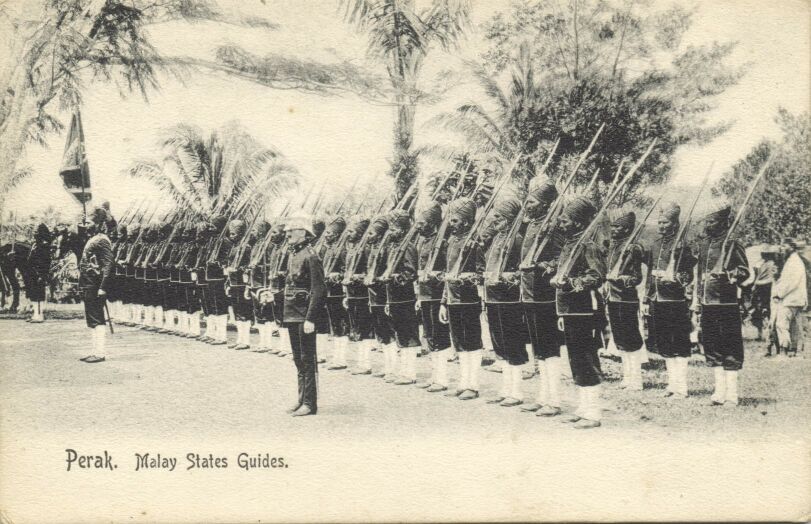
The illustration cover of the book - From the looks of their uniform - Were they Sikhs of the Malay State Guides? or Perak Sikhs ( Local Constabulary )


Edwin A Brown (Indiscreet Memories: Through the eyes of a colonial Englishman)

See below extracted accounts of Edwin’s volunteer stint with the Singapore Volunteer Rifles

1901 Sunday 6 Jan – Singapore Volunteers Corps ( SVC) paraded to the Presbyterian Church for the passing of William Clarke – SGT SVA, who joined Thorneycroft’s Mounted Infantry in 2nd Boer War- Died in Ladysmith on May 1900.

1901 – Arrival of 16th Madras Light Infantry for garrison duties in Singapore

1901- Tue 22 Jan – Queen Victoria died. Perak Lancers; private bodyguard of Sultan of Perak. Edwin joined the SVR ( Singapore Volunteer Rifles ).

Socializing at the “Tingel Tangel” dance hall

1902 -Jan – SVE ( SIngapore Volunteer Engineers ) established to assist RE in the permanent defence of Singapore. The company was divided into Field & Electrical. Was given 100 rounds of ammo for free as incentive to join the SVE, with the next 100 rounds 50% priced.

1902- 3rd & 13th Madras Infantry arrived for garrison duties. No regular battalion of white troops because of the South African War.

1902- 5 Feb Wed; SVC went to camp – “The wet Camp”. Parade of SVC for King’s Birthday, only 6 SVR turned up which was held at the Race Course.

1903 – Chinese New Year – Singapore Volunteers Corps Camp held at the Keppel Golf Course

1903 – 30 March; 1st Battalion Manchester’s arrived from South Africa for Garrison Duty. Presence of HMS Argonaut, HMS Goliath & HMS Glory

“The Bad Old Days” – An account of SVR shortcomings by Edwin to the Singapore Free Press

1904 – 13 March. The SVR had field firing parade at Pasir Panjang. No turn up. The governor directed that SVR to be discontinued and a Maxim gun section formed in lieu of SVR. The section has SVA ( Singapore Volunteer Artillery ) shoulder titles with SVA (M) and wore blue puttees.

This Maxim Company SVC was formed and lasted till the 1930’s as the Machine Gun Company SVC

1904 – 13 Dec: Manchester Regiment marched out to India, 1st Battalion Nott’s & Derby Regiment (Sherwood Foresters) marched in for garrison duties – Residential Regiment will meet at junction of Grange Road & Irwell Bank Road

Change of Regiments: Arriving regiment will arrive at the docks, marched to Kim Seng Road. Then to the junction of Irwell Bank Road & Grange Road. Resident regiment will meet at junction of Grange Road & Irwell Bank Road. There, the resident regiment will welcome the arriving regiment and turn about, together, and the band will play all the way back to Tangling barracks

1904 June – the Chinese discarded their “Tow chang” or queues

1904 10 Nov – Malay Submarine Diving Section of Royal Engineers formed under Lta Ridout

Notes : 1901-21 Oct Rickshaw strike pg 72 , Volunteers Issues page 175 – 180 of Chapter 9 in 1903, Single seated rickshaw appeared 1st time in 1904 page 195,


Thursday, 11 August 2011

Malay States Guides (2) Perak

Malay State Guides shooting at Bisley for the Kolapore Cup, 1908


Malay State Guides ( MSG) 1902 - 1919

Most were sepoys who served in the Indian Army and the European Officers came from the British & Indian army. Native Officers were commissioned by the Governor of the Straits Settlements.

Maxim machine guns were equipped and a battery of 150 gunners and 50 mule handlers , gunned with 7 pdr mountain guns with two 15 pdr field guns were formed. The gunners wore dark blue uniforms and turbans

Early years, the Imperial Defense Committee in London rated the unit as efficient.

1902 – Walker was Lt Col as commandant of the Malaya States Guides and retired in 1910

1910 – Col Murray from the 89th Punjab Regiment was commandant till 1912

1913 – Col OHB Lees from the 53rd Sikh Regiment was CO and led the unit to Aden in 1915

Problems with MSG

- The force did not belong to the Indian nor the British army

- Nor was it a police force

- There was no real true purpose as too much time drilling and little time training for war. Peace, ceremonial soldiering and lack of purpose have sap the regiment’s morale.

Proposed to send MSG overseas on active service was declined as War Office view the MSG as Local Constabulary.

1914 – Was sent to Singapore to embark for service in East Africa. MSG refused as contract obliged them to serve in Malaya. Possible reasons were reports of high casualties in Africa, reluctant to leave businesses built in Malaya during spare time and anti-British sentiments in the ranks.

- Infantry returned to Taiping whilst battery remained in Singapore to bolster defenses after withdrawal of British Battalion.

1915 5 Feb – 5th Light Indian Infantry shared same issues as MSG and mutinied.

1915 – MSG helped to suppress native revolt in Northern States of Kelantan and agreed for overseas services with new contracts in fear of losing livelihoods and careers in case of disbandment.

1915 Sep – MSG joined the Aden Field Force with 900 officers and men, and Tamil laborers.

1919 – MSG returned with 500 men – the death toll was due to sickness rather than battle casualties as most were stricken with diarrhea and dysentery.

Late 1919 – MSG was disbanded due to forgotten theatre in Aden, doubts about their value and CO’s recommendation. Mainly, the men were worn out by Aden’s harsh conditions and decided to return to India. Those remained joined the Federated Malaya States Police Force.

Bibliography : Forgotten Regiments by Berry Renfrew and Google search

Malay State Guides (1) Perak


Malay State Guides (MSG) 1837 - 1897

- As British Influence spread across Malaya, Sultans formed modern constabularies with British assistance to suppress lawlessness in their states

- Forces were modeled on Indian Army and employed British Officers & Indian Sepoys

- MSG soldiers have to be 5 ft 9 – a third of them were 6 ft and wore red tunics & green turbans with silver edgings

Origins of the MSG

Captain Tristian Speedy was a police superintendant in British Penang hired by Mentri, Ngah Ibrahim of Larut to form a Military Police Force

1873 – Resigned as a police official and He returned to Punjab to recruit 110 Sikh sepoys to form the Perak Armed Police

Fought with British force of 200 infantry from 1/ 10th regiment (Penang) and 80th foot regiment(Hong Kong) in Perak war 1875-6 after the murder of First British Resident of Perak. Isabella Bird’s The Golden Chersonese might have mentioned them as “irregulars”.

Lt Col Robert Sandilands Frowd (RSF) Walker (Regular Army Officer) was aide de camp to Sir William Robinson, Governor of Straits Settlements in 1878

1879 - He was named Perak Commissioner of Perak Armed Police, taking over from Major Paul Swinburne

1883 – He recruited 250 Sikhs and Pathans from the 14th/15th & 45th Regiment of the Indian Army

1884 – Unit has 650 men, mostly Indians & 100 Malays. Renamed as 1st Battalion Perak Sikh Military Police ( 1st Perak Sikhs ), with Walker as the commandant with local rank of Major. Selangor & Pahang formed Sikh Military Police Forces on similar lines and helped quell the Pahang rebellion in 1891. The State of Selangor has 530 Selangor Sikhs under Captain H.C.Syers and Pahang has , in 1890 13 Sikh police in Jelebu under Inspector Henessy.

1895 – The Federated Malaya States was formed. The treaty requires all states to maintain a military force. A regular infantry regiment was then formed from the redundant Sikh military police force units

1896 – The regiment was renamed Malaya States Guides, an imitation of India Army’s famous Corps of Guides. 6 companies ( Composition : 4 Sikh comprised Majha Sikhs from Amritsar, Gurdaspur & Lahore in A & B companies, and Malwa Sikhs from Ludhiana, Ferozepur, Ambala, Nabha & Patiala formed C & D companies- the remainder Doaba Sikhs from Jullundur & Hoshiarpur could join any Sikh companies, 1 Punjabi Muslim & 1 Pathan companies) were formed, with a depot company for training recruits. ( A 7th company was raised temporarily during the Boer War to garrison Penang after British troops withdrawn). There were 10 Officers, 8 Native officers & 596 NCOs and men. By the onset of WW1, the force has grown to 900 men.

1897 June - The regiment was sent to march in Queen Victoria’s Diamond Jubilee in London